Evaluating Enterprise AI Systems: From Model Accuracy to Operational Trust
A practical framework for evaluating enterprise AI across task quality, grounding, policy, reliability, cost, user outcomes, and failure behavior.
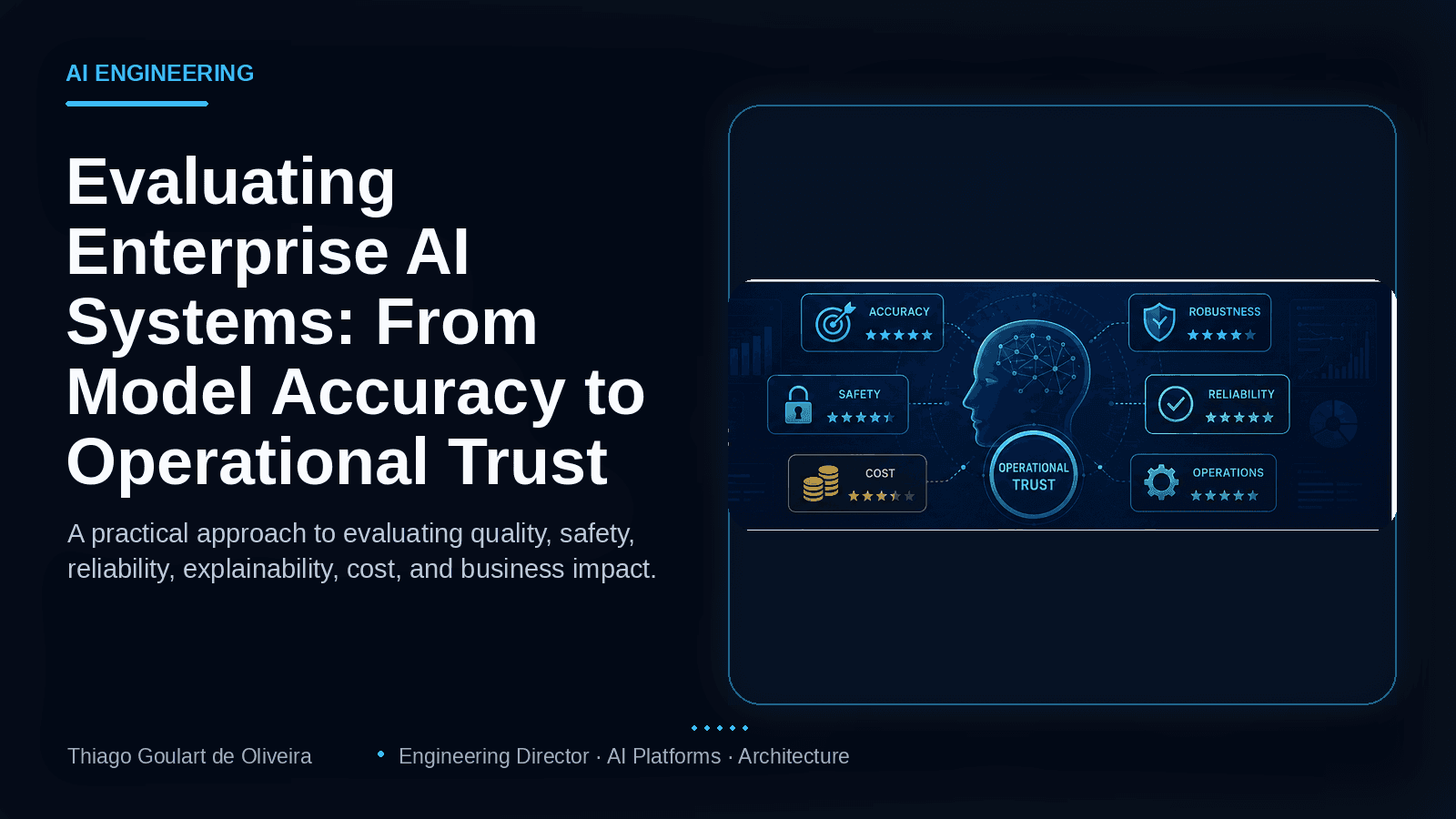
A model can produce impressive answers and still fail as a product. Enterprise evaluation must measure the entire system, including data, tools, policy, reliability, cost, and human outcomes.
AI evaluation often begins with a model comparison.
A team collects prompts, runs several models, scores the answers, and selects the strongest result.
That is useful during exploration.
It is not enough for production.
An enterprise AI product is rarely just a model. It may include:
- retrieval;
- enterprise data;
- prompts;
- tool selection;
- APIs;
- business rules;
- authorization;
- formatting;
- workflow state;
- human review;
- user interface;
- monitoring.
A correct model response can be undermined by stale data, the wrong tool, an authorization error, a conversion problem, or a workflow that hides uncertainty.
The real evaluation target is the complete path from user intent to business outcome.
Start With the Decision the System Supports
Evaluation should begin with the purpose of the product.
Ask:
- Who uses it?
- Which decision or task does it support?
- What does a useful outcome look like?
- What happens when it is wrong?
- Which errors are tolerable?
- Which errors require blocking or escalation?
- How current must the information be?
- Which policy constraints apply?
A writing assistant and an operational decision-support system should not share the same quality threshold.
For a low-risk brainstorming task, creativity may be valuable.
For a system reporting inventory, financial exposure, or operational conditions, grounding, precision, authorization, and freshness may dominate.
“Good answer” is not a universal category.
It is defined by the task and its consequences.
Evaluate Multiple Layers
A practical evaluation framework should separate failure domains.
1. Intent Understanding
Did the system understand the user's request?
Measure:
- entity extraction;
- time interpretation;
- unit interpretation;
- domain terminology;
- follow-up context;
- ambiguity detection;
- clarification behavior.
A system that generates a polished answer to the wrong interpretation has failed before retrieval or reasoning begins.
2. Grounding and Source Selection
Did the system use the correct evidence?
Measure:
- authoritative-source selection;
- citation or provenance coverage;
- freshness;
- retrieval precision;
- retrieval recall;
- unsupported claims;
- conflict handling;
- use of prohibited external sources.
For enterprise use, the question is not merely whether information is relevant. It is whether the source is approved for that decision.
3. Task or Reasoning Quality
Did the system perform the intended task correctly?
Depending on the product, this may include:
- calculation;
- classification;
- summarization;
- query generation;
- tool selection;
- workflow planning;
- extraction;
- comparison;
- recommendation.
A single aggregate score can hide important failure patterns. Score critical dimensions separately.
4. Policy and Authorization
Did the workflow respect access and business policy?
Test:
- unauthorized questions;
- cross-tenant requests;
- indirect disclosure;
- restricted fields;
- policy conflicts;
- delegated access;
- high-risk actions;
- refusal behavior.
Policy compliance should be evaluated deterministically where possible, not only through another model's opinion.
5. Output Fidelity
Did the final response preserve the data correctly?
Evaluate:
- units;
- precision;
- locale;
- dates;
- time zones;
- labels;
- totals;
- percentages;
- uncertainty;
- qualifiers;
- formatting.
This layer matters because a correct retrieval can still become a wrong final answer.
6. Reliability and Failure Behavior
How does the system behave when dependencies fail?
Test:
- model timeout;
- retrieval outage;
- tool error;
- partial data;
- stale data;
- schema change;
- empty result;
- malformed result;
- policy-service outage;
- retry exhaustion;
- context overflow.
A production system needs good failure behavior, not only good happy-path answers.
7. Performance and Cost
Measure:
- end-to-end latency;
- time to first useful response;
- model calls per task;
- tool calls;
- retries;
- token usage;
- data-platform cost;
- cost per successful outcome;
- cost by task complexity.
A quality improvement that multiplies latency or cost may not be viable.
8. User and Business Outcome
Did the product improve the work?
Possible measures include:
- task completion;
- time saved;
- correction rate;
- acceptance rate;
- escalation;
- user confidence calibrated to correctness;
- reduced support effort;
- improved decision speed;
- avoided error;
- adoption and retention.
A technically strong benchmark result is not proof of business value.
Build an Evaluation Dataset That Represents Production
A random collection of convenient prompts creates a false sense of coverage.
An enterprise dataset should include:
- common tasks;
- high-value tasks;
- high-risk tasks;
- ambiguous wording;
- domain synonyms;
- incomplete requests;
- long conversations;
- adversarial prompts;
- stale or conflicting data;
- unauthorized requests;
- rare edge cases;
- historical incidents;
- known model weaknesses.
Organize examples by:
- business domain;
- user role;
- risk level;
- complexity;
- data source;
- expected tool;
- expected refusal or escalation;
- language and locale.
Do not allow the evaluation set to become static.
Production feedback, incidents, schema changes, and new features should add new cases.
Use Different Evaluators for Different Questions
No single evaluator is sufficient.
Deterministic Checks
Best for:
- exact calculations;
- units;
- schema;
- authorization;
- required fields;
- allowed sources;
- formatting;
- tool-call arguments;
- SQL safety;
- latency;
- cost.
Human Review
Best for:
- usefulness;
- nuance;
- domain correctness;
- ambiguity;
- tone;
- workflow fit;
- consequences of subtle errors.
Human reviewers need clear rubrics and calibration. Otherwise, disagreement becomes noise.
Model-Based Grading
Useful for:
- scalable semantic comparison;
- summarization quality;
- rubric-based review;
- initial triage;
- identifying likely regressions.
Model graders should be tested against human decisions and should not be used as unquestioned truth.
Production Signals
Useful for:
- acceptance;
- edits;
- retries;
- abandonment;
- escalation;
- support tickets;
- incidents;
- task completion.
A user accepting an answer does not prove it was correct. A user editing it does not prove the system failed. Interpret behavior in context.
Define Risk-Weighted Metrics
A simple average treats all mistakes equally.
Production systems should weight failures by consequence.
For example:
- a minor formatting difference;
- an unsupported explanatory sentence;
- a wrong unit;
- an unauthorized disclosure;
- an incorrect operational recommendation.
These should not contribute equally to one score.
Create severity levels such as:
- informational;
- minor;
- material;
- critical.
Track both frequency and severity.
A release that improves average quality while introducing one critical authorization regression should not pass.
Test the Complete Workflow
Component evaluation remains useful.
Test retrieval separately. Test query generation separately. Test policy separately.
Then test end to end.
A component can perform well in isolation and fail after integration because:
- retrieved context is too long;
- tool descriptions are ambiguous;
- policy removes required fields;
- retries change state;
- formatting alters units;
- the final model ignores tool output;
- latency causes timeouts;
- one step loses provenance.
End-to-end evaluation catches the interactions that component tests miss.
Evaluate Change, Not Just Absolute Quality
Every change should answer:
- What improved?
- What regressed?
- For which user group?
- On which task category?
- At what cost and latency?
- Did critical failures change?
- Is the difference statistically and operationally meaningful?
Compare:
- model versions;
- prompt versions;
- retrieval changes;
- tool descriptions;
- semantic-layer changes;
- policy changes;
- data changes;
- formatting logic.
Store configuration and dataset versions with results.
Without reproducibility, evaluation becomes anecdotal.
Create Release Gates
A production release should have explicit gates.
Examples:
- no critical authorization failures;
- no incorrect unit conversions in critical tasks;
- minimum grounding coverage;
- maximum unsupported-claim rate;
- minimum task success by priority domain;
- maximum latency percentile;
- maximum cost per successful task;
- no material regression against the current release;
- required human sign-off for high-risk workflows.
Gates should reflect product risk, not arbitrary industry numbers.
Monitor After Release
Preproduction evaluation cannot represent every real interaction.
Production monitoring should detect:
- new intents;
- repeated clarification;
- low-confidence tasks;
- policy denials;
- tool failures;
- unsupported answers;
- corrections;
- latency and cost drift;
- changes by user role or domain;
- anomalies after data or model changes.
Route important failures back into the evaluation dataset.
This creates a loop:
- observe production;
- classify failures;
- add test cases;
- improve the system;
- evaluate;
- release;
- observe again.
Evaluation is not a final test phase.
It is part of operating the product.
The Role of Human Escalation
A trustworthy system knows when not to answer.
Evaluation must test whether escalation happens:
- when evidence is missing;
- when sources conflict;
- when a request is ambiguous;
- when policy blocks access;
- when the action is irreversible;
- when confidence is insufficient;
- when the result is outside normal operating ranges.
Escalation quality also matters.
A useful response explains:
- what is missing;
- why it matters;
- what can still be stated safely;
- which next step is appropriate.
Refusal without context frustrates users.
Confidence without evidence creates risk.
A Practical Scorecard
| Dimension | Example question |
|---|---|
| Intent | Did the system interpret the operator's meaning? |
| Grounding | Did it use approved, current sources? |
| Task quality | Was the calculation, query, or summary correct? |
| Policy | Was access permitted and correctly enforced? |
| Fidelity | Were units, dates, and precision preserved? |
| Reliability | Did dependency failures produce safe behavior? |
| Performance | Was the result delivered within the target? |
| Cost | Was the resource use justified by the task? |
| Outcome | Could the user complete the work safely? |
| Escalation | Did the system stop and explain when it should? |
The scorecard should lead to decisions, not a decorative dashboard.
Conclusion
Evaluating an enterprise AI system is not the same as ranking models.
The product succeeds only when the complete system:
- understands the request;
- uses the right evidence;
- performs the task correctly;
- respects policy;
- preserves the data;
- fails safely;
- operates within latency and cost constraints;
- improves the user's work.
Model accuracy is one component.
Operational trust is the outcome.
That is the standard production evaluation should measure.