From Software Engineer to Engineering Director: 24 Years of Reinvention
Reflections on a career shaped by software engineering, architecture, entrepreneurship, leadership, and the need to keep learning.

A letter to my past self about technology, leadership, unconventional career decisions, and the importance of remaining adaptable.
Dear me in 2002,
You are about to take your first professional steps as a software engineer.
You do not know where they will lead, and that uncertainty is making you question whether you are choosing the right technology, company, or career.
You are looking for a clear path.
I need to tell you something that will take years to understand:
There will be no clear path.
Your career will not follow a predictable sequence of promotions. It will move through software engineering, architecture, project management, entrepreneurship, executive leadership, consulting, and eventually the leadership of engineering teams building enterprise AI products.
At times, that path will look inconsistent from the outside.
It will make sense later.
The First Bet
Your interest in programming started before your first professional role.
Your father worked as a systems analyst with large-scale mainframes, and his work made technology feel both mysterious and practical. Computers were not merely devices. They were tools capable of organizing information, automating work, and solving problems that would otherwise require substantial human effort.
You will pick up a Visual Basic book with more than 500 pages, written entirely in English.
You will barely understand the language.
You will read it anyway.
That experience will establish a pattern: you will frequently need to learn before you feel ready.
In 2002, you will build your career around Microsoft technologies and the emerging .NET ecosystem.
It will be useful. You will enter the market while the platform is still establishing itself in Brazil, and your knowledge will place you in projects across banking, insurance, logistics, retail, hospitality, and media.
You will spend years working with languages, frameworks, databases, servers, and development tools.
They will matter, but not for the reason you initially believe.
The most valuable thing you will learn is not a programming language.
It is how to understand a problem well enough to build something people can depend on.
Systems Rarely Work Alone
One theme will appear repeatedly: integration.
You will connect applications, payment systems, authentication services, digital accounts, external platforms, and enterprise databases.
The hardest problems are rarely contained inside a single application.
They exist at the boundaries:
- between systems;
- between teams;
- between technical and business requirements;
- between what was designed and what operations need;
- between what a product promises and what its architecture can sustain.
This will move you from software development toward solution architecture.
You will stop looking only at components and begin looking at relationships, constraints, failure modes, security, data flows, and long-term consequences.
That transition will not happen because someone gives you a title.
It will happen because the problems become larger than the code.
The Unconventional Decision
At one point, your career will appear conventional:
Software Engineer. Lead Software Engineer. Solutions Architect. Project Manager.
Then you will step away from that path to help build and lead a company.
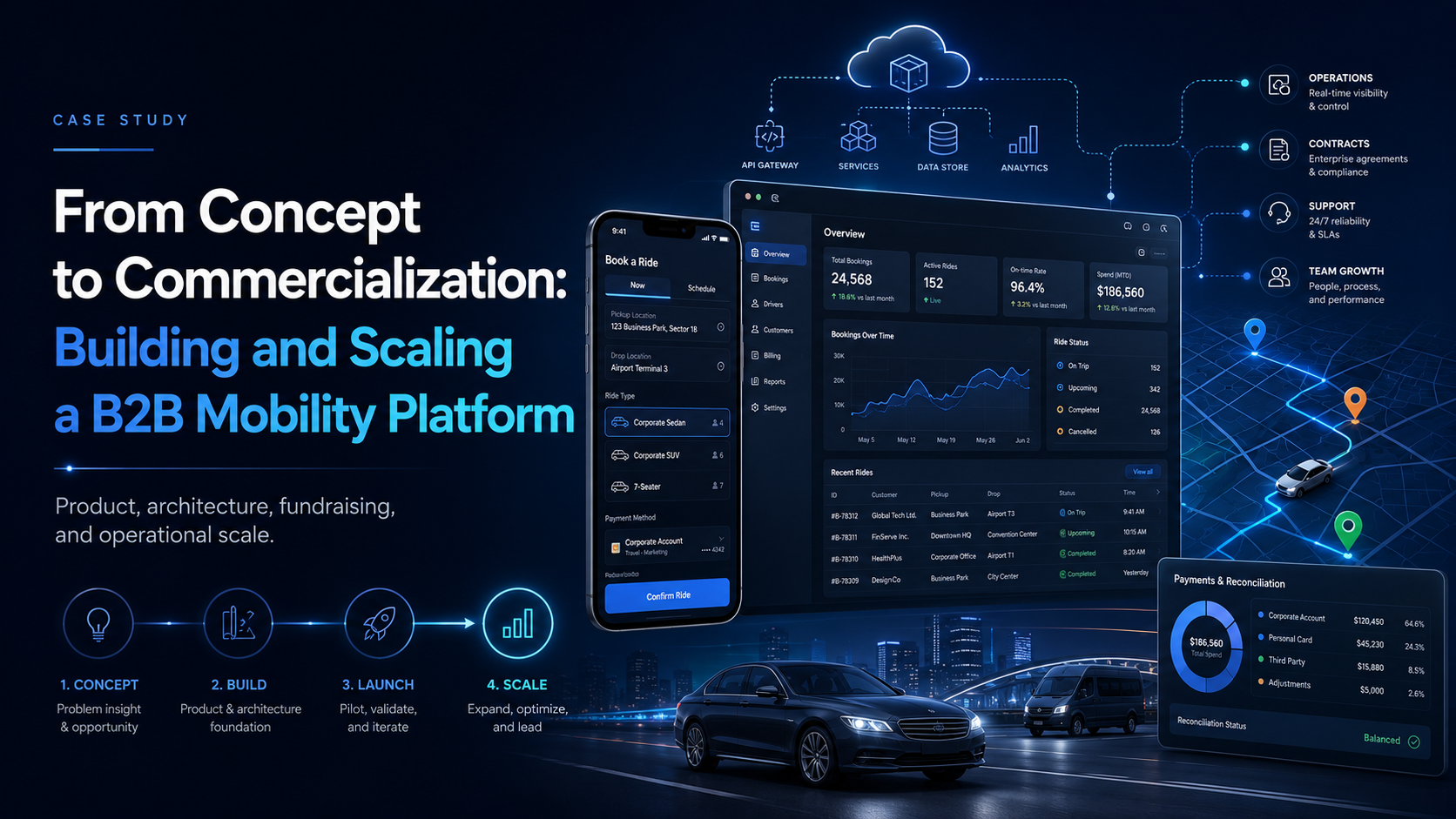
You will take responsibility for a B2B mobility and payment product. An idea will need to become a working product, commercial proposition, operating company, and organization capable of supporting real customers.
Technical challenges will be only part of the work.
You will also think about:
- product direction;
- customer expectations;
- contracts;
- cash flow;
- hiring;
- team structure;
- delivery commitments;
- operational incidents;
- investor expectations;
- commercial priorities;
- the consequences of a wrong decision.
You will help lead a funding round and scale the organization to approximately 50 professionals across engineering, product, design, marketing, commercial, and administrative functions.
This will change the way you think about engineering.
As a developer, it is natural to focus on whether a solution is technically correct.
As an architect, you consider whether it is scalable, secure, resilient, and maintainable.
As a company leader, you must also ask:
- Can the organization afford it?
- Can the team operate it?
- Does it solve a problem customers will pay to solve?
- Can it be delivered in the available time?
- What happens when it fails?
- Is this the most important problem now?
You will discover that technical excellence without context can become another form of waste.
A sophisticated solution is not necessarily a good solution. The right solution balances customer value, risk, cost, time, organizational capability, and technical sustainability.
You will not learn that from a certification.
You will learn it by being accountable for the entire outcome.
Returning to Architecture
After years in executive leadership, you will return to software engineering and solution architecture.
Some people may interpret that as a step backward.
It will not feel that way.
The technology landscape will have changed. Cloud platforms, containers, microservices, automated delivery, distributed data systems, and new operational practices will be central.
You will need to catch up.
That process will be uncomfortable because past experience does not eliminate the need to become a beginner again.
You will study. You will rebuild technical depth. You will work closely with product, quality, data, DevOps, and engineering teams. You will design cloud-native and multi-cloud solutions. You will return to hands-on decisions with a broader understanding of business and organizational consequences.
The years spent running a company will make you a different kind of architect.
You will no longer evaluate architecture only through diagrams and patterns. You will consider who needs to build it, who must operate it, how quickly it can create value, and whether the organization is prepared for its complexity.
Career progression is not always vertical.
Sometimes the most important move is sideways.
Sometimes it is back toward the work itself.
Learning to Work Across Borders
English will be difficult.
There will be frustration and moments when you question whether you can communicate effectively in an international environment.
Continue anyway.
English will become more than another professional skill. It will provide access to people, ideas, companies, and opportunities that would otherwise remain distant.
You will work with distributed teams across countries and time zones. You will learn that international collaboration requires more than vocabulary:
- clear written communication;
- cultural awareness;
- patience;
- explicit expectations;
- careful documentation;
- the ability to disagree without unnecessary conflict.
Remote work will make geography less restrictive, but it will also expose unclear thinking. When people cannot rely on physical proximity, leaders must communicate context, decisions, and priorities with greater precision.
Those hours spent learning another language will prove valuable in ways you cannot yet see.
Another Reinvention
Years later, you will lead engineering work around enterprise AI platforms.
The systems will combine conversational interfaces, large language models, agent-based workflows, APIs, structured enterprise data, and cloud-native infrastructure.
The technologies will be new, but many underlying problems will be familiar.
Systems still need reliable integration.
Data still needs ownership and governance.
Users still need clear answers.
Security and authorization still cannot be optional.
Engineering teams still need context, standards, feedback, and room to make responsible decisions.
Generative AI will not make decades of software engineering irrelevant. It will make architectural judgment even more important.
A prototype can be built quickly.
A dependable product still requires careful work.
Continuous learning is not about chasing every technology. It is about developing enough adaptability to understand which changes matter, which principles remain valid, and which assumptions must be reconsidered.
What I Would Tell You Now
1. Technical Depth Creates Options, but Judgment Creates Impact
Knowing how systems work will give you credibility and independence.
Knowing when to use that knowledge—and when not to—will make you effective.
2. Your Career Does Not Need to Be Linear
Moving from engineering into management, management into entrepreneurship, and executive leadership back into architecture will not weaken your career.
Each transition will add a perspective that the next role requires.
3. Building a Company Changes How You Evaluate Engineering
Once you are responsible for customers, contracts, hiring, operations, and funding, architecture stops being an abstract technical exercise.
Every decision has an organizational and economic cost.
4. Technologies Expire Faster Than Principles
Languages, frameworks, and platforms will change.
Clear thinking, modular design, security, observability, disciplined execution, and respect for users will remain important.
Do not confuse attachment to a tool with professional identity.
5. Leadership Is Not Control
You will be tempted to solve every difficult problem yourself.
Resist that instinct.
A leader creates clarity, builds capability, establishes standards, provides feedback, and helps others make good decisions without depending on one person for every answer.
6. Learning Is Part of the Job
Experience will never remove the need to learn.
Seniority does not mean having seen every problem. It means approaching unfamiliar problems without pretending that they are familiar.
7. Connections Matter—in Systems and in People
Much of your technical career will involve connecting systems not designed to work together.
Much of your leadership career will involve doing the same with people, teams, incentives, and objectives.
Both require understanding the interfaces.
The Path Will Make Sense Later
You are beginning this journey believing that a successful career requires choosing the correct technology and following the expected progression.
It does not.
Technologies will change.
Titles will change.
Organizations will change.
What will remain is curiosity, the willingness to solve difficult problems, the ability to adapt, and the desire to help teams build things that matter.
You will be a developer, architect, manager, entrepreneur, consultant, and engineering director.
None of those identities will replace the others.
They will accumulate.
The apparent detours will become part of your advantage.
Keep learning.
Keep questioning your assumptions.
Do not be afraid to take the path that does not look like progression to everyone else.
You will understand its value later.
With gratitude,
Your future self