Choosing a Distributed Cache: Consistency, Availability, Cost and Operational Trade-offs
A decision framework for selecting and operating distributed caching based on data semantics, failure behavior, consistency, cost, and organizational capability.
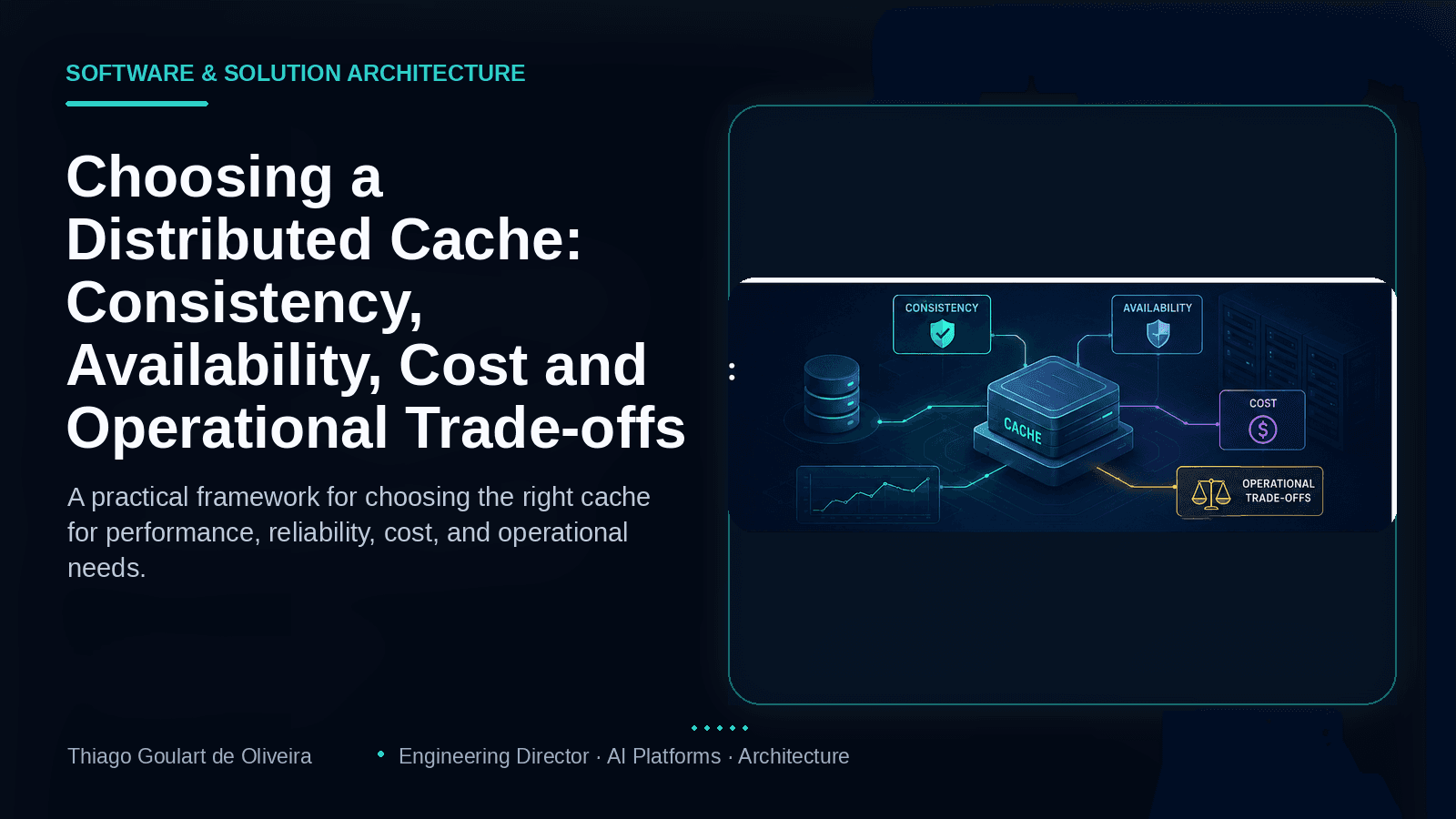
A cache can reduce latency and cost, but it also creates another version of truth. The first decision is not which product to use. It is whether the system should cache the data at all.
Distributed caches are often introduced with a simple argument:
The database is too slow, so place the data in memory.
That can work.
It can also turn a straightforward data flow into a distributed consistency problem.
A cache changes more than latency. It affects:
- correctness;
- failure behavior;
- data ownership;
- capacity;
- operational complexity;
- security;
- observability;
- cost;
- incident response.
The decision should therefore begin with the business and data semantics, not a comparison table of Redis, Memcached, Hazelcast, Ignite, Aerospike, Couchbase, or managed cloud offerings.
The product matters.
The operating model matters more.
Start With the Problem
Before choosing a cache, identify the constraint.
Common goals include:
- reducing read latency;
- protecting a database from repeated reads;
- absorbing traffic spikes;
- avoiding repeated expensive computation;
- storing session state;
- coordinating rate limits;
- sharing temporary state across instances;
- reducing calls to a paid or constrained dependency;
- enabling fast lookup of derived data.
These are different problems.
A session store has different correctness requirements from a product catalog.
A rate limiter has different atomicity requirements from a rendered-page cache.
An expensive analytical result has different freshness expectations from an account balance.
If the problem is unclear, the cache becomes a generic performance layer with undefined correctness.
Ask Whether Caching Is Appropriate
A cache may be unnecessary when:
- the database query can be indexed or redesigned;
- a materialized view or precomputed data product is more appropriate;
- the response is not requested frequently;
- the data changes too often;
- stale values are unacceptable;
- invalidation cannot be defined;
- the team cannot operate another distributed dependency;
- the cost saved is smaller than the complexity added.
Caching is not a substitute for understanding the workload.
Measure:
- request rate;
- latency distribution;
- database time;
- repeated-query ratio;
- object size;
- cardinality;
- update frequency;
- acceptable staleness;
- miss penalty;
- dependency cost;
- peak behavior.
The strongest cache is the one the system does not need.
Define the Source of Truth
A cache should not accidentally become an ungoverned database.
For every cached item, define:
- authoritative source;
- owner;
- key;
- value schema;
- freshness requirement;
- invalidation trigger;
- fallback behavior;
- data classification;
- retention;
- maximum acceptable staleness.
The application should know whether the cache contains:
- a copy;
- a derived value;
- temporary state;
- coordination state;
- the only current value.
That last case is no longer ordinary caching. It is primary data storage and needs stronger durability, recovery, and governance.
Select a Caching Pattern Deliberately
Cache-Aside
The application reads the cache first. On a miss, it reads the source and populates the cache.
Advantages:
- simple;
- only requested data is cached;
- resilient to a cache flush when the source remains available.
Risks:
- stale data;
- duplicated loading logic;
- many concurrent misses;
- first request pays the full latency;
- invalidation remains explicit.
Read-Through
The cache layer loads data from the source.
Advantages:
- application code can be simpler;
- loading behavior is centralized.
Risks:
- tighter coupling to cache capabilities;
- less transparent failure behavior;
- product-specific implementation.
Write-Through
Writes update the cache and backing store synchronously.
Advantages:
- cache remains current after successful writes;
- predictable read behavior.
Risks:
- write latency;
- dual-system failure handling;
- transaction boundaries;
- unused data may be cached.
Write-Behind
Writes reach the cache first and are persisted asynchronously.
Advantages:
- low write latency;
- batching opportunity.
Risks:
- data loss;
- ordering;
- replay;
- complex recovery;
- the cache behaves like a primary system.
Write-behind is not a performance toggle. It is an architectural commitment.
Consistency Is a Product Decision
Ask what happens when the cache and source disagree.
Possibilities include:
- stale reads are harmless;
- stale reads confuse users;
- stale reads violate a contract;
- stale reads create financial loss;
- stale reads create safety risk.
The acceptable model may be:
- eventual consistency;
- bounded staleness;
- read-your-writes;
- monotonic reads;
- strong consistency for selected operations;
- no caching for critical data.
A single application may need several models.
For example:
- public catalog content can tolerate minutes of staleness;
- user preferences may need read-your-writes;
- permissions should usually be current;
- financial balance may require authoritative reads;
- configuration may require version-aware invalidation.
Do not apply one TTL to all data because it is convenient.
Invalidation Must Be Designed
Cache invalidation is difficult because the system must know when a cached answer is no longer valid.
Strategies include:
- time-to-live;
- explicit deletion after a write;
- versioned keys;
- event-driven invalidation;
- dependency-based invalidation;
- namespace rotation;
- short caching plus background refresh.
TTL is not a complete invalidation strategy. It defines how long an error may survive.
For each value, ask:
- What event makes it invalid?
- Who publishes that event?
- What happens if the event is lost?
- Can consumers process it more than once?
- How are old keys removed?
- How will schema changes affect values?
- How is invalidation tested?
Versioned keys can simplify migrations:
customer-profile:v3:{customer-id}
They do not remove the need to control old data and memory growth.
Prevent Cache Stampedes
When a popular key expires, many requests may attempt to rebuild it simultaneously.
This can overload the source the cache was meant to protect.
Controls include:
- request coalescing;
- distributed locks with careful timeouts;
- stale-while-revalidate;
- probabilistic early refresh;
- jittered TTLs;
- background refresh;
- bounded concurrency;
- circuit breakers.
A lock can also create failure if its owner dies or the timeout is wrong.
The objective is to limit duplicate work, not to introduce an indefinite dependency.
Design for Hot Keys and Uneven Workloads
Traffic is rarely uniform.
A small number of keys may receive a large share of requests.
Hot keys can cause:
- overloaded partitions;
- network concentration;
- CPU bottlenecks;
- eviction pressure;
- latency spikes.
Potential mitigations include:
- local near-cache;
- replication;
- key sharding for counters;
- precomputation;
- batching;
- different TTLs;
- request coalescing;
- workload-specific data structures.
Do not assume adding nodes solves a single-key bottleneck.
Decide What Failure Means
The cache will fail.
Possible failures include:
- complete outage;
- partial partition loss;
- network timeout;
- stale replicas;
- failover;
- eviction;
- memory pressure;
- restart;
- corrupted or incompatible serialization;
- regional outage.
For each use case, choose:
Fail Open
Bypass the cache and use the source.
Useful when correctness matters and the source can handle the load.
Risk: a cache outage becomes a database outage.
Fail Closed
Reject the operation.
Useful when cache state is required for security, coordination, or protection.
Risk: availability decreases.
Degrade
Return older data, fewer features, or a simplified response.
Useful when bounded staleness is acceptable.
The behavior should be intentional and tested.
Persistence Is Not the Same as Durability
Some cache products support snapshots, append-only logs, replicas, and disk tiers.
That does not automatically make cached data durable enough to become the primary record.
Evaluate:
- recovery point;
- recovery time;
- replication acknowledgment;
- failover semantics;
- backup;
- restore testing;
- data loss during failover;
- consistency after recovery;
- regional protection.
If losing the cache means losing business records, treat it as a database.
Multi-Region Changes the Trade-off
A cache close to users can reduce latency, but multi-region replication raises questions:
- Which region accepts writes?
- How are conflicts resolved?
- How stale may remote data be?
- What happens during a partition?
- Can a user move between regions and see older state?
- Are keys or values regulated by geography?
- Is global replication cost justified?
Strong global consistency can add latency and reduce availability.
Local caches can improve performance but expose different versions.
The right design depends on the data, not a general preference for global distribution.
Security and Data Classification
In-memory does not mean low risk.
Cached data may include:
- personal data;
- tokens;
- session state;
- permissions;
- financial information;
- internal configuration;
- proprietary results.
Controls may include:
- network isolation;
- TLS;
- authentication;
- least-privileged access;
- encryption;
- key and secret management;
- tenant separation;
- command restrictions;
- data minimization;
- short retention;
- secure backups;
- protected logs.
Do not place highly sensitive data in a cache merely because access is fast.
Managed or Self-Hosted?
Managed services reduce some operational burden, but not architectural responsibility.
A managed cache may provide:
- provisioning;
- patching;
- failover;
- monitoring;
- backups;
- scaling;
- support.
You still own:
- keys and schemas;
- TTLs;
- invalidation;
- consistency;
- application failure behavior;
- capacity planning;
- cost;
- security configuration;
- incident response.
Self-hosting may offer control or portability, but it requires mature operations.
Choose based on:
- team capability;
- reliability target;
- data sensitivity;
- deployment environment;
- required features;
- portability;
- support;
- total cost.
License cost is rarely the complete cost.
Capacity and Cost
Estimate:
- number of keys;
- average key size;
- average value size;
- metadata overhead;
- replication factor;
- fragmentation;
- headroom;
- write amplification;
- network traffic;
- backup/persistence cost;
- cross-region transfer;
- peak growth.
A rough memory estimate is:
(key bytes + value bytes + per-entry overhead) × key count × replication × headroom
Real measurements are better than theoretical calculations.
Monitor cost per useful hit, not just cluster cost.
A cache with a low hit rate may add cost and complexity without reducing source load.
Observability
Track:
- hit and miss rate;
- latency percentiles;
- errors and timeouts;
- evictions;
- memory usage;
- fragmentation;
- hot keys;
- connection saturation;
- command rate;
- replication lag;
- failovers;
- load time;
- source fallback;
- stampede events;
- invalidation delay;
- stale-read reports;
- cost by workload.
A high hit rate is not sufficient. A cache can be fast and wrong.
Correlate cache behavior with user and system outcomes.
A Decision Framework
| Question | Lower-complexity choice | Higher-complexity choice |
|---|---|---|
| Staleness acceptable? | TTL/cache-aside | event invalidation or authoritative read |
| Data rebuildable? | no persistence | persistence and recovery |
| Load uniform? | basic partitioning | hot-key mitigation |
| Cache outage survivable? | fail open | degradation or fail closed |
| Single region? | regional service | cross-region design |
| Team has operations capacity? | managed service | self-hosted where justified |
| Simple values? | key/value | richer data structures or compute |
| Cost predictable? | fixed capacity | elastic or tiered service |
This table narrows the decision. It does not select a product automatically.
Product Selection Comes Last
After requirements are explicit, compare products across:
- data structures;
- atomic operations;
- consistency;
- clustering;
- failover;
- persistence;
- replication;
- multi-region support;
- security;
- observability;
- ecosystem;
- managed-service availability;
- licensing;
- operational skill;
- cost.
A simple managed Redis-compatible service may be the right answer for many workloads.
For some, Memcached is sufficient.
For others, a distributed data grid, durable key-value store, database, materialized view, or no cache is more appropriate.
The right product is the one whose failure and consistency model fit the application.
Conclusion
A distributed cache is not merely a faster place to store data.
It is another stateful system with its own truth, failure, security, and cost behavior.
The first decision is not which technology has the longest feature list.
It is:
- what problem is being solved;
- which data may be stale;
- how invalidation works;
- what happens during failure;
- whether the organization can operate the result.
A cache creates value when it reduces meaningful latency or cost without making correctness and operations unmanageable.
That is an architecture decision, not a benchmark result.